Global Healthcare Digital Twin Market to Surge at 27% CAGR, Powered by Smart Healthcare till 2030

Health

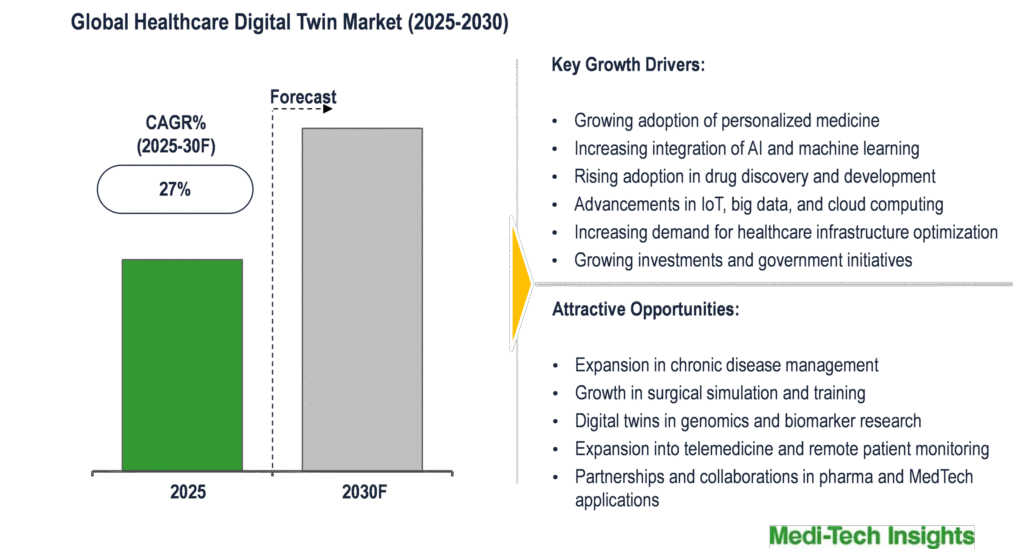
The global healthcare digital twin market is estimated to be approximately US$ 2.1 billion in 2024 and is set to witness a growth rate of ~27% in the next 5 years. Growing adoption of personalized medicine; increasing integration of AI and machine learning; rising adoption in drug discovery and development; advancements in IoT, big data, and cloud computing; increasing demand for healthcare infrastructure optimization; and growing investments and government initiatives are some of the key factors driving the healthcare digital twin market.

A healthcare digital twin is a virtual replica of a patient, medical device, or healthcare system that uses real-time data, AI, and analytics to simulate, predict, and optimize health outcomes. It integrates data from medical records, wearables, imaging, and genomics to create personalized models for disease progression, treatment planning, and drug discovery. Digital twins enhance precision medicine, optimize hospital operations, and improve medical training through simulations. By enabling predictive analytics and remote monitoring, they support early diagnosis, personalized therapies, and operational efficiency, revolutionizing patient care and healthcare innovation while reducing costs and improving overall treatment effectiveness.

Unlock key findings! Fill out a quick inquiry to access a sample report
https://meditechinsights.com/healthcare-digital-twin-market/request-sample/

See also  Antihistamine Drugs Market Estimates & Forecast, By Application, segments 2024−2029

Growing adoption of personalized medicine to propel market demand

The growing adoption of personalized medicine is driving the healthcare digital twin market by enabling tailored treatment strategies based on individual patient data. Digital twins create virtual patient models using genomics, biometrics, and real-time health data, allowing clinicians to simulate disease progression and predict treatment responses. This enhances precision medicine, optimizing drug dosages, therapy selection, and surgical planning. Additionally, digital twins help in early disease detection, remote monitoring, and chronic disease management, reducing trial-and-error treatments. As demand for customized healthcare solutions rises, digital twin technology is becoming essential for improving patient outcomes and accelerating drug development.

Rising adoption in drug discovery and development is driving the market growth

The rising adoption of digital twins in drug discovery and development is driving market growth by enhancing virtual testing, predictive modeling, and personalized drug design. Digital twins simulate disease progression, drug interactions, and patient responses, reducing reliance on costly and time-consuming clinical trials. By integrating AI, big data, and real-world patient data, they help pharmaceutical companies identify promising drug candidates, optimize formulations, and predict adverse effects. This accelerates FDA approvals, improves trial success rates, and lowers R&D costs. As pharma companies increasingly adopt AI-driven simulations, digital twins are revolutionizing precision medicine and therapeutic innovations.

See also  Global Urology Devices Market Overview The global urology devices market is poised for steady expansion and is projected to grow at a CAGR of approximately 6–7% during the forecast period from 2024 to 2029. This growth trajectory is primarily driven by the rising prevalence of urological disorders and urological cancers across both developed and developing regions. Key Request a free sample copy or view report summary: https://meditechinsights.com/urology-devices-market/request-sample/ An increasing global geriatric population is significantly contributing to market growth, as aging individuals are more prone to conditions such as benign prostatic hyperplasia, urinary incontinence, kidney stones, and bladder dysfunction. Advancements in urology treatment modalities and medical technologies are enabling more accurate diagnosis and effective treatment of complex urological conditions. Despite positive growth prospects, the high initial cost associated with advanced urology equipment and the shortage of skilled urologists in certain regions may restrain market expansion to some extent. Definition and Scope of Urology Devices Urology devices comprise a broad range of medical instruments and equipment used for the diagnosis, monitoring, and treatment of disorders affecting the urinary tract and male reproductive system. These devices are widely utilized in hospitals, specialty clinics, ambulatory surgical centers, and urology practices. Common urology devices include endoscopes, catheters, laser systems, lithotripters, robotic surgical systems, and various surgical instruments. Urology devices play a critical role in managing conditions such as kidney stones, prostate cancer, urinary incontinence, erectile dysfunction, and bladder disorders. Continuous innovation in this field is improving procedural efficiency, patient comfort, and clinical outcomes. Shift Toward Minimally Invasive Urological Procedures The urology devices market is witnessing a strong shift toward minimally invasive surgical procedures. Minimally invasive techniques offer significant advantages, including reduced hospital stays, shorter recovery times, and lower risk of post-operative complications. Procedures such as laparoscopic and robotic-assisted surgeries are becoming increasingly common in urology practices. Endoscopic devices and laser-based technologies are widely used for stone removal, prostate treatments, and tumor ablation. The growing preference for minimally invasive approaches is driving demand for advanced urology devices with enhanced precision and control. Integration of Digital Technologies in Urology Digital transformation is playing an increasingly important role in the evolution of the urology devices market. The integration of artificial intelligence is enhancing diagnostic accuracy and supporting clinical decision-making in urology procedures. Advanced imaging systems provide real-time visualization, enabling urologists to perform complex procedures with greater confidence. Telemedicine solutions are improving patient access to urology consultations, particularly in remote and underserved regions. Digital platforms are also enabling better treatment planning, patient monitoring, and post-procedure follow-up. Technological Advancements Driving Market Growth Rapid technological advancements are a key factor fueling growth in the urology devices market. Innovations in robotics have significantly improved the precision of procedures such as prostatectomy and nephrectomy. Robotic-assisted urological surgeries allow for enhanced dexterity, improved visualization, and greater surgical accuracy. Laser technologies used in lithotripsy and soft tissue ablation are becoming more efficient and safer for patients. Enhanced imaging systems and navigation technologies are reducing procedural risks and improving overall outcomes. Impact of Aging Population on Urology Device Demand The aging global population is a major driver of demand for urology devices. Older adults are more susceptible to urological conditions due to physiological changes and age-related degeneration. Benign prostatic hyperplasia is highly prevalent among elderly men and often requires long-term management or surgical intervention. Urinary incontinence and bladder dysfunction are also common among aging populations, increasing the need for diagnostic and therapeutic devices. As life expectancy continues to rise, the demand for urology devices is expected to grow steadily. Rising Incidence of Urological Disorders The prevalence of urological disorders is increasing globally, contributing significantly to market growth. Lifestyle-related factors such as obesity, diabetes, smoking, and poor dietary habits are increasing the risk of urological diseases. Kidney stones are becoming more common due to changes in diet and fluid intake patterns. Rising incidence of prostate and bladder cancers is driving demand for advanced diagnostic and treatment devices. Early diagnosis and effective management of these conditions rely heavily on modern urology devices. Growth Opportunities in Emerging Markets Emerging markets are expected to offer significant growth opportunities for the urology devices market. Rapid urbanization and improving healthcare infrastructure are enhancing access to specialized urological care. Governments in emerging economies are increasing investments in healthcare modernization and medical equipment procurement. Rising awareness of urological health and availability of trained specialists are further supporting market expansion. The growing middle-class population and increasing healthcare expenditure are driving demand for advanced urology devices in these regions. Challenges Limiting Market Expansion High acquisition and maintenance costs of advanced urology devices pose a challenge for healthcare providers, particularly in resource-limited settings. Limited availability of skilled urologists and trained technicians can restrict the adoption of sophisticated technologies. Regulatory approval processes and compliance requirements may increase time-to-market for new devices. Reimbursement constraints in certain healthcare systems may limit patient access to advanced urology procedures. Impact of Private Equity Investment in Urology Practices Private equity investment is emerging as an important growth catalyst within the urology devices market. Financial backing from private equity firms enables urology practices to improve operational efficiency and expand service offerings. Access to capital allows practices to invest in advanced urology devices and cutting-edge technologies. Private equity involvement supports consolidation and modernization of fragmented urology practices. Between January 2018 and 2022, only 26 urology-related private equity deals were recorded, indicating significant untapped consolidation potential. In comparison, other specialties such as dermatology, orthopedics, gastroenterology, and cardiology have seen substantially higher deal activity. A large proportion of practicing urologists are nearing retirement age, creating opportunities for private equity-led acquisitions. According to the American Urological Association, more than 55% of private practice urologists were aged 65 or older in 2022. Private equity deals offer retiring physicians the option to maintain ownership stakes while transitioning out of clinical practice. Competitive Landscape Analysis The global urology devices market is highly competitive, with the presence of established multinational corporations and specialized medical device companies. Leading players focus on continuous innovation, product differentiation, and portfolio expansion to maintain competitive advantage. Strategic acquisitions and mergers are commonly used to strengthen market presence and expand technological capabilities. Partnerships with healthcare providers and research institutions support product development and clinical validation. New product launches targeting minimally invasive and digitally integrated solutions are shaping competitive dynamics. Future Outlook of the Urology Devices Market The urology devices market is expected to witness sustained growth driven by technological innovation and increasing disease burden. Ongoing advancements in robotics, imaging, and digital health will continue to transform urological care. Replacement demand and technology upgrades will support steady growth in developed markets. Emerging economies will present strong expansion opportunities due to improving healthcare access and rising patient awareness. Overall, the global urology devices market offers attractive long-term growth potential supported by demographic trends, innovation, and expanding clinical applications. Key Players in the Global Urology Devices Market •Boston Scientific Corporation •Medtronic •Coloplast •Baxter International •Becton Dickinson •Stryker Corporation •Olympus Corporation •ConvaTec •B. Braun Melsungen AG •Fresenius Medical Care Get Free Sample Report: https://meditechinsights.com/urology-devices-market/request-sample/ About Medi-Tech Insights Medi-Tech Insights is a healthcare-focused business research & insights firm. Our clients include Fortune 500 companies, blue-chip investors & hyper-growth start-ups. We have completed 100+ projects in Digital Health, Healthcare IT, Medical Technology, Medical Devices & Pharma Services in the areas of market assessments, due diligence, competitive intelligence, market sizing and forecasting, pricing analysis & go-to-market strategy. Our methodology includes rigorous secondary research combined with deep-dive interviews with industry-leading CXO, VPs, and key demand/supply side decision-makers

Competitive Landscape Analysis

The global healthcare digital twin market is marked by the presence of established and emerging market players such as Amazon Web Services, Inc., Certara; ANSYS, Inc., Oracle, GE Healthcare, Atos, Siemens, IBM Corporation, Microsoft Corporation, Philips Healthcare, and Dassault Systèmes; among others. Some of the key strategies adopted by market players include new product development, strategic partnerships and collaborations, and geographic expansion.

Get exclusive insights – download your sample report today
https://meditechinsights.com/healthcare-digital-twin-market/request-sample/

Global Healthcare Digital Twin Market Segmentation

This report by Medi-Tech Insights provides the size of the global healthcare digital twin market at the regional- and country-level from 2023 to 2030. The report further segments the market based on offering, application, end user.

Market Size & Forecast (2023-2030), By Offering, USD Million

  • Software
  • Services

Market Size & Forecast (2023-2030), By Application, USD Million

  • Drug Discovery and Development
  • Surgical Planning & Medical Education
  • Medical Device Design & Testing
  • Workflow Optimization & Asset Management
  • Personalized Medicine
  • Others
See also  Medical Devices Outsourcing Market- Strategy, Revenue, Opportunity, Business Segment Overview and Key Trends 2024-2029

Market Size & Forecast (2023-2030), By End User, USD Million

  • Pharma & Biotech Companies and Clinical Research Organizations (CROs)
  • Medical Device Companies
  • Others

Market Size & Forecast (2023-2030), By Region, USD Million

  • North America
    • US
    • Canada
  • Europe
    • UK
    • Germany
    • France
    • Italy
    • Spain
    • Rest of Europe
  • Asia Pacific
    • China
    • India
    • Japan
    • Rest of Asia Pacific
  • Latin America
  • Middle East & Africa

About Medi-Tech Insights

Medi-Tech Insights is a healthcare-focused business research & insights firm. Our clients include Fortune 500 companies, blue-chip investors & hyper-growth start-ups. We have completed 100+ projects in Digital Health, Healthcare IT, Medical Technology, Medical Devices & Pharma Services in the areas of market assessments, due diligence, competitive intelligence, market sizing and forecasting, pricing analysis & go-to-market strategy. Our methodology includes rigorous secondary research combined with deep-dive interviews with industry-leading CXO, VPs, and key demand/supply side decision-makers.

Contact:

Ruta Halde
Associate, Medi-Tech Insights
 +32 498 86 80 79
info@meditechinsights.com 

Leave a Reply